
Advance Care Planning

The Gift of Clarity
This is one of the most compassionate truths about advanced care planning. While it can feel uncomfortable to think about, formalizing your wishes is truly a final act of love.
When you don't leave a clear map, your family is often forced to make agonizing, high-stakes medical decisions in the middle of a crisis. They are left wondering, "Did we do the right thing?" or "Is this what they would have wanted?"—questions that can breed lifelong guilt and conflict.
By wrapping up your wishes in an Advance Directive (which typically includes a Living Will and a Medical Power of Attorney), you remove that heavy burden from their shoulders. You replace panic and second-guessing with a clear, comforting guide, allowing your loved ones to focus on honoring your life rather than navigating a medical crisis in the dark.
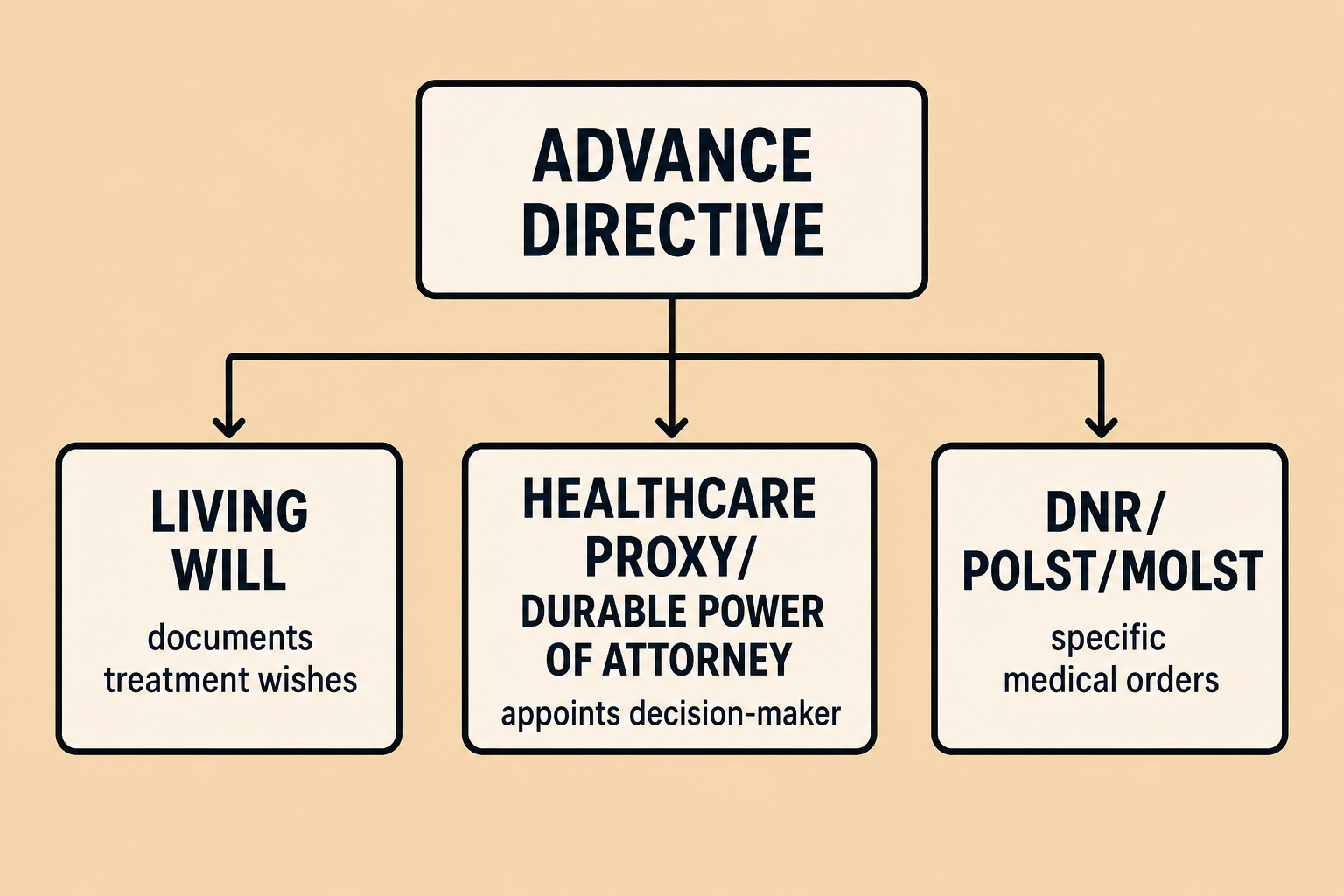
Advance Directives consist of three parts:
Living Will - what you want
Healthcare Proxy - who will make decisions for you when you can’t
DNR or POLST/MOLST orders must be completed with a medical provider. MD, DO, APRN, PA
DNR -Do Not resuscitate or allow natural dath
POLST - Physician orders of life sustaining treatment
MOLST - Medical orders of life sustainting treatments
MYTH BUSTER:
A living will does NOT mean you have a Do Not Resuscitate (DNR).
DNR is an order written by a medical provider at the appropriate time.
Navigating Advance Care Planning can be a challenging and complex process.
It is often completed:
As part of estate planning with an attorney.
Or independently using downloadable forms.

If the time comes when I am incapacitated to the point when I can no longer actively take part in decisions for my own life, and am unable to direct my physician as to my own medical care, I wish this statement to stand as a statement of my wishes. I, ________________________________, the author of this document, request that, if my condition is deemed terminal or if I am determined to be permanently unconscious, I be allowed to die and not be kept alive through life support systems. By terminal condition, I mean that I have an incurable or irreversible medical condition which, without the administration of life support systems, will, in the opinion of my attending physician, result in death within a relatively short time. By permanently unconscious I mean that I am in a permanent coma or persistent vegetative state which is an irreversible condition in which I am at no time aware of myself or the environment and show no behavioral response to the environment.
An example taken from the Advance Care Directive Document for the State of Connecticut
States have different forms
Specific Instructions Listed below are my instructions regarding particular types of life support systems. This list is not all-inclusive. My general statement that I not be kept alive through life support systems provided to me is limited only where I have indicated that I desire a particular treatment to be provided.
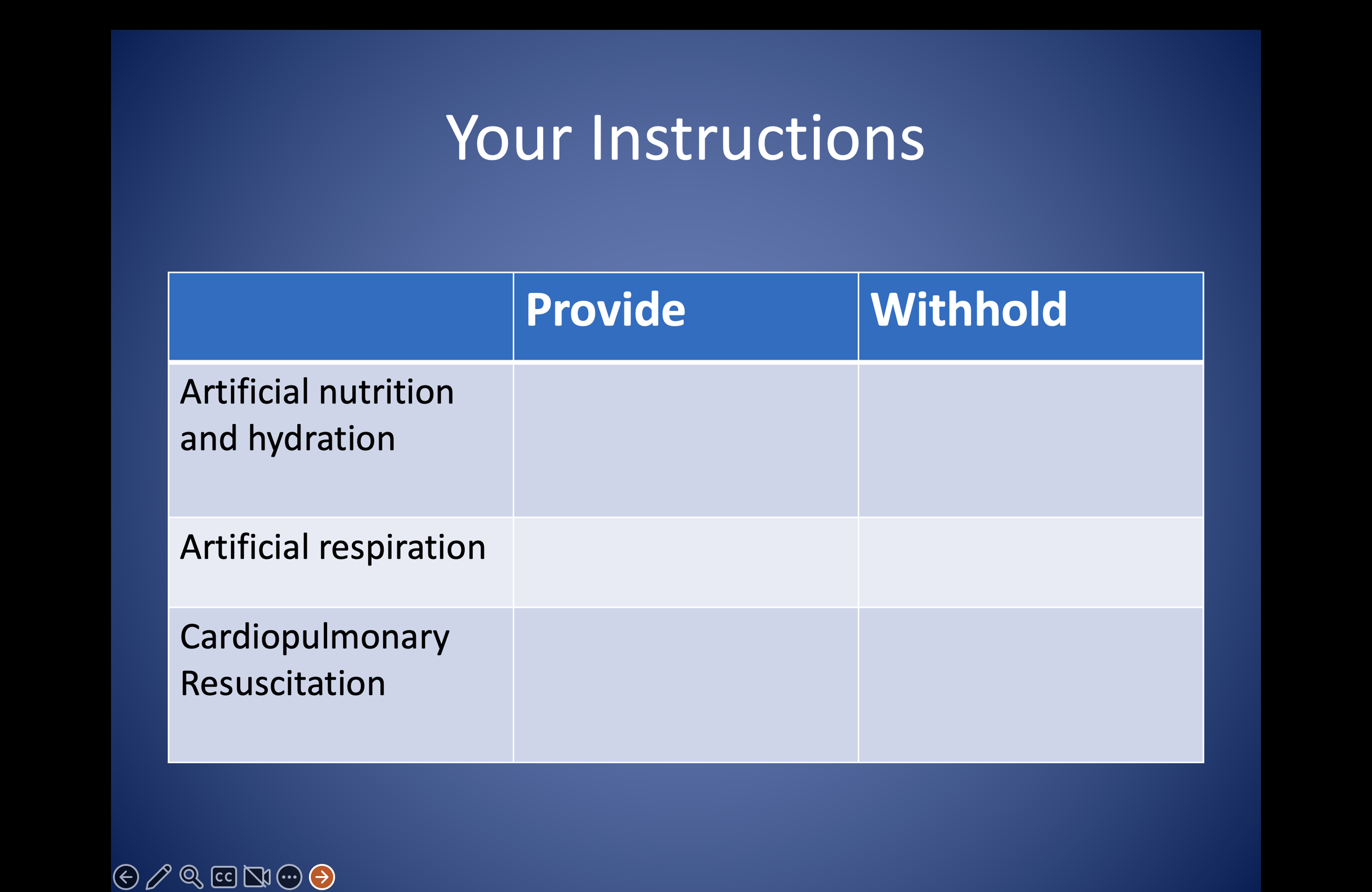
Important Choices reduced to checking off a box with no guidance.
Many of us are asked to make these important medical decisions without fully understanding what those choices mean.
Fear of death often drives decisions to pursue every possible treatment, even when the costs—physical, emotional, and personal—may be significant.
We believe people deserve clear, realistic information about end-of-life options so they can make informed decisions that reflect their values, priorities, and goals.
It is important to begin these conversations when you are well. These conversations and decisions become more painful and difficult to process during the end of a loved one’s life.
Advance Care Presentations
Our compassionate and practical presentations provide
realistic information about advance care planning.
Helping individuals and families prepare for some of life's most difficult decisions. In a supportive, nonjudgmental setting.
We explore medical, emotional, and practical aspects of serious illness, end-of-life care, and decision-making.
Participants will gain the knowledge, confidence, and tools needed to communicate their wishes, advocate for their values.
Make informed choices during times of crisis, reducing uncertainty and empowering themselves and their loved ones when it matters most.